
On this page
Which gutter problems can be repaired?
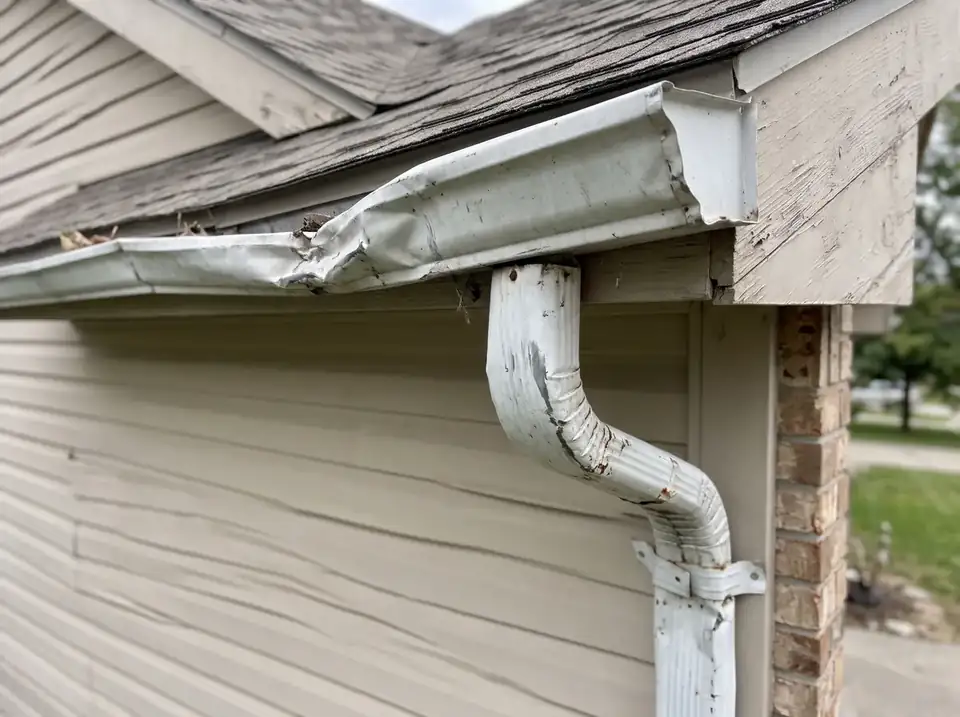
Most of them. The usual Cleveland repair list is short: joints that drip, runs that sag, sections dented by hail or bent by limbs, gutters that overflow in heavy rain, fascia that has rotted behind the gutter, and downspouts that are clogged or have come loose. Each has a standard fix, and most take a few hours.
What causes each problem, and what fixes it?
| Problem | Usual cause | Usual repair | Page |
|---|---|---|---|
| Drip at a corner or end cap | Failed sealant | Clean, rivet, reseal | Leaking gutters |
| Run sags or leans | Loose spikes, wide spacing, soft wood | New hidden hangers, fascia repair | Sagging gutters |
| Dents, kinks, torn sections | Hail, wind, falling limbs | Replace section or run | Hail and storm damage |
| Spills over in downpours | Too small, too few downspouts, clogs | Diverters, extra downspouts, 6-inch | Heavy-rain overflow |
| Water behind the gutter | No drip edge, rotted fascia | Drip edge or apron, new boards | Fascia and soffit |
| Downspout barely drains | Leaves in elbows, crushed pipe | Clear, flush, replace sections | Downspout repair |
How does a repair visit run?
Find the source
The contractor traces where water is getting out: a joint, a low spot, a blocked outlet, or water slipping behind the gutter.
Check the wood
The fascia around the problem is probed, because a repair on rotten wood will not last.
Make the fix
Reseal, rehang, replace a section, clear a downspout or add drainage, depending on the cause.
Test with water
A hose run in the gutter confirms the leak has stopped and water reaches the outlet.
Point out other weak spots
A good contractor flags old spikes or a corner close to failing, without pushing a full replacement.
Why do Cleveland gutters need repairs?
Three local conditions cause most of the work.
Rain volume. With about 57.6 inches of precipitation in an average year, Cleveland gutters fill often. Joints that are never quite dry fail sooner, and gutters that are slightly undersized show it in every spring storm.
Severe storms. Spring and early summer bring thunderstorms with wind and hail, and occasionally tornadoes. On April 27, 2011, the National Weather Service office in Morristown rated tornadoes near Cleveland and Hopewell up to EF2, and on April 12, 2020, it surveyed an EF2 tornado with estimated peak winds of 115 mph that began just south-southeast of Cleveland. Storms on that scale bend and tear gutters and pull downspouts off walls.
Trees. Oaks, maples, tulip poplars and pines fill gutters through the year. Packed wet leaves add weight that pulls hangers loose, and clogged outlets send water over the front.
When is replacement the better call?
Repair makes sense when the gutters are basically sound. Think about replacement when you see several of these:
- Leaks at most joints, not just one or two.
- Old sectional gutters with a seam every 10 feet.
- Rust holes in steel gutters, or splits along the run.
- Gutters that overflow even when clean.
- Spike-hung runs that keep dropping however often they are refixed.
- Fascia rot along most of the house.
The repair or replace guide sets out the trade-offs.
What does gutter repair cost?
Repairs are usually priced as a visit plus parts and time rather than by the foot. Resealing a few corners and adding hangers on a one-story house costs far less than replacing a hail-damaged run on a two-story wall. Fascia carpentry, height and drainage work add the most to a repair bill. Ask for each item to be listed separately.
Can you repair gutters yourself?
Small jobs on a one-story house, such as clearing an outlet or adding a downspout extension, are within reach for many homeowners. Ladders on wet or uneven ground are the risk. Leave second-story work, roofs near power lines and anything involving storm damage to a contractor.
Repair terms explained
| Term | What it means on a Cleveland house |
|---|---|
| Miter | The corner joint where two runs meet. It is riveted and sealed, and it is the first place most gutters start to drip. |
| End cap | The piece that closes off the end of a run. It is crimped or riveted and sealed, and it is the next most common leak. |
| Spike and ferrule | The old way of hanging gutters: a long nail through a metal sleeve into the board. Heat, cold and weight slowly pull it loose. |
| Hidden hanger | A bracket that clips under the front lip of the gutter and screws through the back into the fascia, out of view from the ground. |
| Fascia | The board running along the ends of the rafters. Every hanger screws into it, so a soft fascia means a gutter that will not stay put. |
| Soffit | The panel underneath the overhang, often vented. Dark stains or peeling paint here are a sign water is running behind the gutter. |
| Drip edge | A bent metal strip along the roof edge that pushes runoff out into the gutter rather than letting it curl back onto the wood. |
| Gutter apron | A wider strip of flashing slipped under the shingles and lapped over the back of the gutter to close the gap water likes to find. |
| Outlet | The opening in the gutter floor, with a short sleeve called a drop, that feeds water into the downspout. |
| Cleanout | A removable fitting where the downspout meets a buried line, so debris can be pulled out before it reaches the pipe. |
| Downspout strap | A metal band holding the downspout to the wall, usually every 6 to 8 feet, so wind and storms cannot pull it away. |
| Valley diverter | A small metal splash guard where a roof valley meets the gutter, so the fast stream from the valley stays in the trough. |